Today, we took Cleo for her 3rd acupuncture session, and it went well as did the previous two times. So some of you must be wondering why we have been taking her for acupuncture.
Well the simple reason is because Western medicine has not been able to diagnose her condition and we are at a loss with what to do with her.
 |
| Some needles in Cleo's back |
What is wrong with Cleo? As mentioned some time back, Cleo developed a severe intolerance to exercise, ad we discovered that she had an extremely enlarged heart. However, all other tests (blood, urine, ECG, ultrasound, stress test etc) - some of which has been repeated - has shown that she is a perfectly healthy dog.
So I switched her to a raw diet with a number of supplements, and she has improved significantly. However, she still isn't 100% well.
Last month, she suddenly had trouble getting up and walking. She was circling and her head was drooping! It was quite bad and we were worried that she might have had a stroke. She was examined thoroughly and had another blood test done, but everything came back perfect!
She also seemed to be a bit more lethargic since that episode, and so I finally decided to take her for acupuncture sessions.
 |
| Close up of an acupuncture needle in Cleo |
So some of you might be wondering - is there a certified acupuncturist in this country for animals? Well you'll be surprised to know that there is. She is
Dr Susanna Brida-Hofherr.
"Dr. Susanna Brida-Hofherr has a degree in Veterinary Medicine (Dr. Med. Vet.) from the Veterinary University of Vienna, Austria. She also is a Fellow of the Royal College of Veterinary Surgeons (RCVS) in London, England. In order to practice veterinary acupuncture, she went on to obtain qualifications from the International Veterinary Acupuncture Society (IVAS). Dr. Susanna is now a Certified Practitioner of Animal Acupuncture."
I had read about Dr Susanna on many occasions, but never thought that I would require her services until now.
Dr Susanna is very thorough and will grill you on a million things about your pet on your first visit, and subsequent visits, to her very comfortable (in my opinion) clinic. While some people may not like this, I was very glad that she was and is so detailed. It gave me a sense of comfort and reassurance that she knew what she was doing.
Additionally, all needles used are single-use sterile needles which means that your pet is safe and will not be at risk of contracting any diseases etc from other pets.
While most people would think that acupuncture is a whole load of nonsense, I beg to differ. Up until last year, I too pooh pooh-ed acupuncture. You see, I developed some sort of reaction to something - I don't know what - where my face got extremely swollen to the point that it was bruising. And several visits to the regular doctors, where I was prescribed super strong anti-biotics and weeks of steroids, did absolutely nothing for it.
A very close friend suggested that I try acupuncture, and I thought - what did I have to loose? And so I did... and guess what, I saw an improvement just after the first session. By the third session, the swelling had completely subsided, and by the 10th session, all the bruising etc had gone too. So I guess that made me believe in acupuncture as an alternative.
So far, while I cannot say that acupuncture is definitely helping Cleo just yet, what I do know is that at least I now have some sort of diagnosis for Cleo, and more importantly access to a "vet" that has a very different approach to medicine and nutrition.
In the mean time, I have extracted this from the
International Veterinary Acupuncture Society to give all of you an idea of what acupuncture is all about.
*************************************
Veterinary Acupuncture
-extracted from the International Veterinary Acupuncture Society
 |
| A needle in her foreleg |
What is Veterinary Acupuncture?
Acupuncture may be defined as the insertion of needles into specific points on the body to produce a healing response. Each acupuncture point has specific actions when stimulated. This technique has been used in veterinary practice in China for thousands of years to treat many ailments.
The Chinese also use acupuncture as preventative medicine. Acupuncture is used all around the world, either along or in conjunction with Western medicine, to treat a wide variety of conditions in every species of animal. Clinical research has been conducted showing positive results in the treatment of both animals and humans, and the use of acupuncture is increasing. Acupuncture will not cure every condition, but it can work very well when it is indicated.
For Which Conditions is Acupuncture Indicated?
Acupuncture is indicated for functional problems such as those that involve paralysis, noninfectious inflammation (such as allergies), and pain. For small animals, the following are some of the general conditions which may be treated with acupuncture:
- Musculoskeletal problems, such as arthritis, intervertebral disk disease, or traumatic nerve injury
- Respiratory problems, such as feline asthma
- Skin problems such as lick granulomas and allergic dermatitis
- Gastrointestinal problems such as diarrhea
- Selected reproductive problems
For large animals, acupuncture is again commonly used for functional problems. Some of the general conditions where it might be applied are the following:
- Musculoskeletal problems such as sore backs or downer cow syndrome
- Neurological problems such as facial paralysis
- Skin problems such as allergic dermatitis
- Respiratory problems such as heaves and “bleeders”
- Gastrointestinal problems such as nonsurgical colic
- Selected reproductive problems
In addition, regular acupuncture treatment can treat minor sports injuries as they occur and help to keep muscles and tendons resistant to injury. World-class professional and amateur athletes often use acupuncture as a routine part of their training. If your animals are involved in any athletic endeavor, such as racing, jumping, or showing, acupuncture can help them keep in top physical condition.
How Does Acupuncture Work?
Although acupuncture has its roots in ancient times before modern scientific methods were available with which to study it, many important studies have been done to indicate how acupuncture works and what physiologic mechanisms are involved in its actions.
Using functional MRI (fMRI), to examine 15 different points, the basic tenets of acupuncture have been proven. Those are that acupuncture is based upon the point selected, the method of stimulation, and the duration of stimulation. Stimulation of these points result in specific changes in the central nervous system. It was shown that acupuncture points that have pain relieving properties associated with them tend to activate specific pain-association brainstem regions.
The National Institute of Health developed a consensus statement about acupuncture and its efficacy. NIH said that there was compelling evidence that acupuncture was useful in the management of osteoarthritis and musculoskeletal pain.
In western medical terms, acupuncture can assist the body to heal itself by affecting certain physiological changes. For example, acupuncture can stimulate nerves, increase blood circulation, relieve muscle spasm, and cause the release of hormones, such as endorphins (one of the body’s pain control chemicals) and cortisol (a natural steroid). Although many of acupuncture’s physiological effects have been studied, many more are still unknown. Further research must be conducted to discover all of acupuncture’s effects and its proper uses in veterinary medicine.
Is Acupuncture Painful?
For small animals, the insertion of acupuncture needles is virtually painless. The larger needles necessary for large animals may cause some pain as the needle passes through the skin. In all animals, once the needles are in place, there should be no pain. Most animals become very relaxed and may even become sleepy. Nevertheless, acupuncture treatment may cause some sensation, presumed to be those such as tingles, cramps, or numbness which can occur in humans and which may be uncomfortable to some animals.
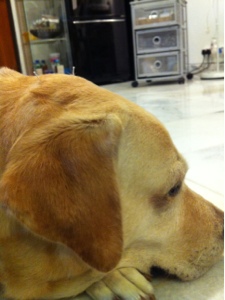 |
| Acupuncture needles in Cleo's head and neck area |
Is Acupuncture Safe for Animals?
Acupuncture is one of the safest forms of medical treatment for animals when it is administered by a properly trained veterinarian. Side effects of acupuncture are rare, but they do exist. An animal’s condition may seem worse for up to 48 hours after a treatment. Other animals become lethargic or sleepy for 24 hours. These effects are an indication that some physiological changes are developing, and they are most often followed by an improvement in the animal’s condition.
How Can My Pet Benefit from Acupuncture?
The success of the treatment will vary according to the skill of the veterinarian, the condition being treated and the number and frequency of acupuncture treatments. The length and frequency of the treatments depends on the condition of the patient and the method of stimulation (dry needle, electroacupuncture, aquapuncture, etc.) that is used by the veterinary acupuncturist. A simple acute problem, such as a sprain, may require only one treatment, whereas more severe or chronic ailments may need several treatments.
How Safe is Acupuncture?
Acupuncture should never be administered without a proper veterinary medical diagnosis and an ongoing assessment of the patient’s condition by a licensed veterinarian. This is critical because acupuncture is capable of masking pain or other clinical signs and may delay proper veterinary medical diagnosis once treatment has begun. Elimination of pain may lead to increased activity on the part of the animal, thus delaying healing or causing the original condition to worsen.
In general, acupuncture can be effectively combined with most conventional and alternative therapies. Certified Veterinary Acupuncturists have the comprehensive training, knowledge and skill to understand the interactions between different forms of treatment and to interpret the patient’s response to therapy.
The American Veterinary Medical Association considers veterinary acupuncture a valid modality within the practice of veterinary medicine and surgery.
 |
| Cleo - relaxing with acupuncture |
How Should I Choose a Veterinary Acupuncturists for My Pet?
There are two important criteria you should look for in a veterinary acupuncturist:
- Your veterinary acupuncturists must be a licensed veterinarian.
- Your veterinary acupuncturist should have formal training in the practice of veterinary acupuncture.
In most countries, states, and provinces, veterinary acupuncture is considered a surgical procedure that only licensed veterinarians may legally administer to animals.
A veterinarian is in the best position to properly diagnose an animal’s health problem and then to determine whether the animal is likely to benefit from an acupuncture treatment, or whether its problem requires chemical, surgical, or no intervention.
Because of the differences in anatomy, and the potential for harm if the treatments are done incorrectly, only a properly trained veterinarian should perform acupuncture on animals. The proper training for a veterinarian would include an extensive post-doctoral educational program in veterinary acupuncture.
The more your veterinarian knows about traditional Chinese philosophies and the western scientific basis for acupuncture the more you can be assured that your animals will be treated properly.


.JPG)


